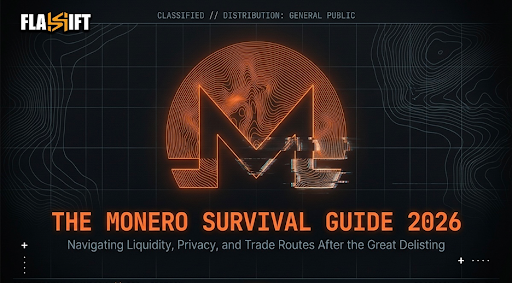
The year 2025 will be remembered as the year of the “Great Delisting.” Under immense regulatory pressure, major centralized exchanges (CEXs) across Europe and Asia removed privacy coins from their listings. For the average investor, it seemed like the end of Monero (XMR).
But for the crypto-native, it was merely a migration. Monero didn’t die; it went dark. In 2026, Monero volume is hitting new highs, but the venue has changed. The liquidity has moved from centralized order books to decentralized aggregators and atomic swaps.
This guide is for the trader who refuses to compromise on privacy. We will explore how to navigate this new landscape and find the Best XMR Swap routes that offer speed, low fees, and most importantly, zero compromise on anonymity.
Why Monero is Under Attack (And Why It Matters)
Monero is the only cryptocurrency that fulfills the original promise of “Digital Cash.” Unlike Bitcoin, which has a transparent ledger where every transaction can be tracked by surveillance firms, Monero uses Ring Signatures and Stealth Addresses to obfuscate the sender, receiver, and amount.
This feature makes it “fungible”—meaning 1 XMR is always equal to 1 XMR, regardless of its history. Regulators dislike this because it blinds them. However, for users living under oppressive regimes, or simply those who value their right to financial privacy, XMR is essential.
The Challenge: The Liquidity Drought
When Binance and Kraken delisted XMR, they created a “Liquidity Drought” for retail users. You can no longer simply log in to a popular app and buy Monero with a credit card.
This created a gap in the market. Users were left asking: “Where can I trade XMR without getting flagged?”
The answer lies in Chain Abstraction platforms. These non-custodial aggregators have stepped in to become the new liquidity backbone for the privacy sector.
Criteria for the Best Monero Exchange
Finding a safe harbor for XMR trades requires a strict checklist. In 2026, you cannot afford to be careless.
- No-KYC Policy: This is non-negotiable. If you have to upload an ID to buy a privacy coin, you have already broken the privacy chain.
- Non-Custodial Architecture: Never leave XMR on a platform. The risk of seizure is too high. The swap must settle directly to your private wallet (like Cake Wallet or GUI).
- High Liquidity/Low Spread: Many small exchanges charge a 5-10% premium on XMR due to scarcity. The Best XMR Swap is one that aggregates multiple sources to keep the price close to the global spot rate.
- Support for Cross-Chain Swaps: You need to be able to move from transparent chains (like BTC or USDT) into XMR seamlessly.
Top Contenders for XMR Swapping
- Flashift: Currently the leader in the aggregator space for privacy assets. Flashift’s AI router specifically filters for “No-KYC” partners, ensuring that your XMR trade doesn’t trigger a compliance freeze. It aggregates liquidity from remaining friendly exchanges and decentralized atomic swap pools to offer the tightest spread.
- LocalMonero (P2P): A classic peer-to-peer option. While great for privacy, the premiums are often high (5-10% above market), and the process is slow and manual.
- Atomic DEXs: Protocols like BasicSwap offer trustless trading. While technically impressive, the liquidity is often low, and the user experience is complex for the average trader.
Step-by-Step: Executing a Private Swap
Here is the workflow for a secure XMR acquisition using an aggregator:
- Preparation: Set up a non-custodial Monero wallet (e.g., Monerujo or Cake Wallet) and copy your receiving address.
- Selection: Go to a privacy-focused aggregator. Select your input currency (e.g., USDT TRC20 for low fees) and select XMR as the output.
- Execution: The platform generates a one-time deposit address. Send your USDT.
- Settlement: The Chain Abstraction layer handles the conversion in the background. Within minutes, the XMR arrives in your private wallet.
Conclusion: Privacy is a Feature, Not a Crime
The crackdown on Monero has ironically proven its value proposition. If a financial asset requires permission to be used, it is not money; it is a credit. Monero is money.
While the on-ramps have become fewer, the infrastructure to trade it has become more robust. By utilizing advanced aggregators, you can continue to access the world’s most private digital asset without exposing your identity to the surveillance state.